
Onboard Communication Gateway for Commuter Rolling Stock
A compact, galvanically isolated onboard TCMS communication gateway developed by NSAD for Jakarta commuter rolling stock, with a working proof of concept in approximately two weeks.

- Delivery year
- 2025
- Region
- Jakarta, Indonesia
- Application
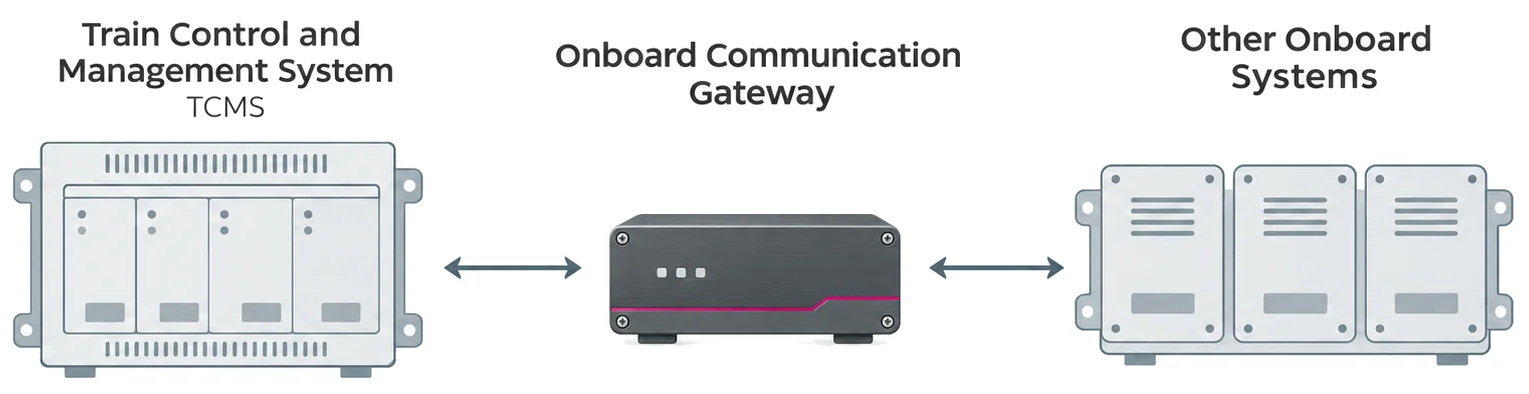
- Onboard communication interface between the Train Control and Management System (TCMS) and other onboard systems in Jakarta urban commuter rolling stock.
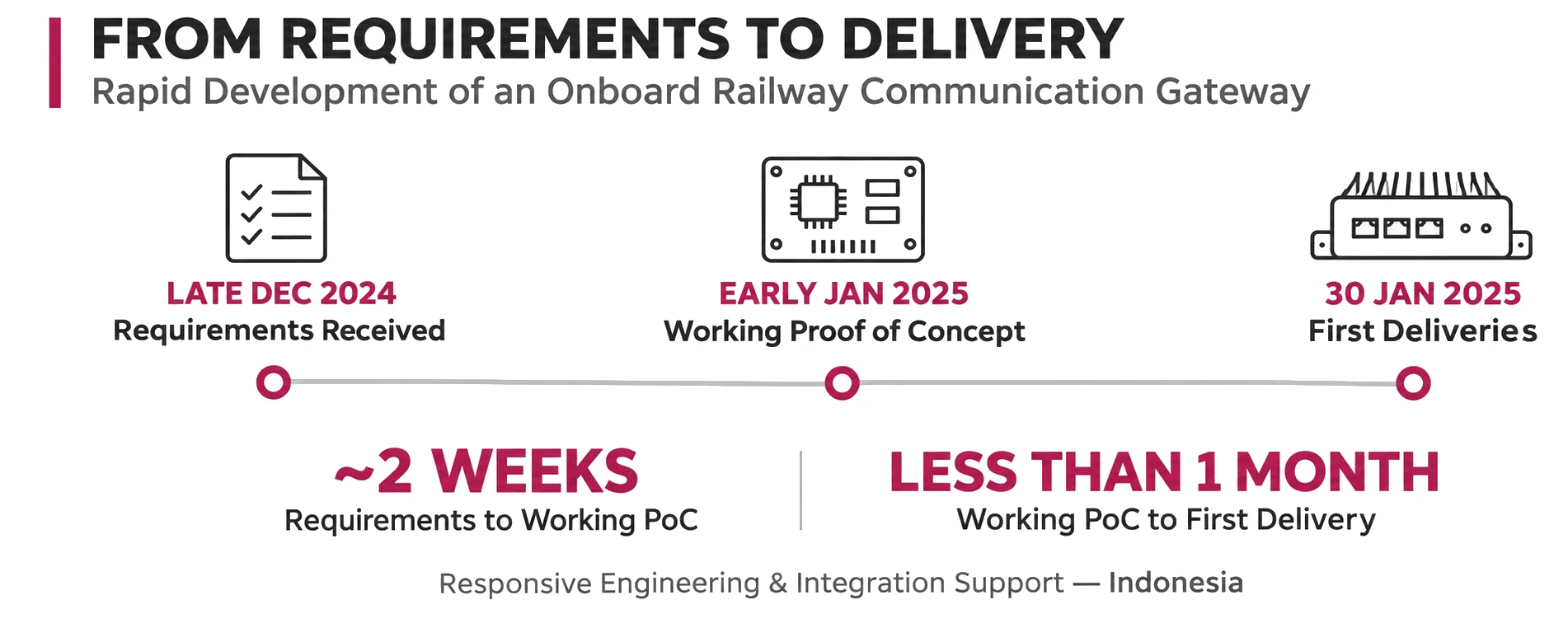
In 2025, NSAD developed and delivered onboard communication gateways for urban commuter rolling stock in Jakarta. The gateways interface the Train Control and Management System (TCMS) with other onboard systems. Following receipt of the initial requirements in late December 2024, NSAD produced a working proof of concept (PoC) in the first week of January 2025 and began deliveries on 30 January 2025. The gateways have been installed, commissioned, and are operating in service.
Engineering Challenge
Reliable communication between TCMS and other onboard systems requires electrical isolation, predictable message timing, and diagnostic monitoring under railway operating conditions. The project called for a dedicated embedded system tailored to the onboard interface requirements, with a compact design suitable for installation in space-constrained onboard panels. The development schedule was also demanding, requiring rapid progression from initial requirements to a working prototype and production delivery.
NSAD Solution
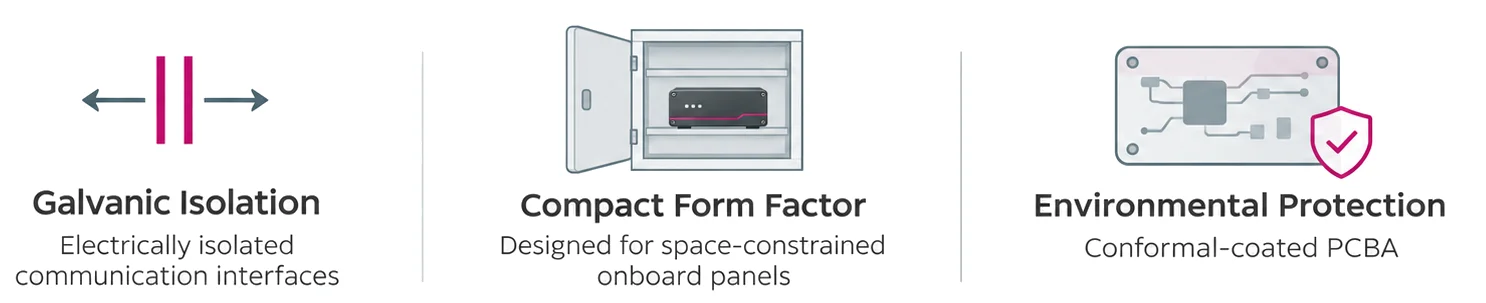
NSAD developed the gateway hardware and embedded firmware for a nominal 110 VDC train battery supply. Each gateway provides galvanically isolated communication interfaces, with isolation between the interfaces and from the train battery supply. Communication performance includes end-to-end message-transfer latency under 10 ms and a separate gateway conversion response time of 1 ms. Embedded functions include watchdog supervision, power supply monitoring, communication timeout detection, and fault indication. The printed circuit board assembly (PCBA) is conformal-coated to help protect the circuitry against moisture and environmental contaminants in demanding onboard conditions. Its compact form factor supports installation in small electrical panels where space is limited.
Direct collaboration with integration teams in Indonesia enabled quick clarification of requirements, short technical feedback loops, and responsive engineering support during development and integration. This local engineering accessibility was an important advantage for a time-sensitive railway project.
Delivery and Operational Deployment
NSAD received the initial requirements in late December 2024 and developed a working PoC in approximately two weeks, by the first week of January 2025. Initial deliveries began on 30 January 2025, less than one month after the PoC and less than two months after the initial inquiry.
NSAD’s scope covered electronic hardware design, communication protocol implementation, embedded firmware development, manufacturing, testing, system integration, and commissioning. The gateways entered operational service in Jakarta commuter rolling stock. The project demonstrates NSAD’s ability to combine dedicated railway communication engineering with rapid local development, manufacturing, and practical integration support.
Technical Highlights
- Nominal train battery supply
- 110 VDC
- Onboard communication interfaces
- Galvanically isolated communication interfaces
- Electrical isolation
- Interface-to-interface and battery supply isolation
- End-to-end message-transfer latency
- Under 10 ms
- Gateway conversion response time
- 1 ms
- Embedded processing
- Embedded processing with integrated diagnostic and fault-monitoring functions
- PCBA environmental protection
- Conformal-coated PCBA for added protection in demanding onboard environments
- Compact installation
- Space-efficient form factor for installation in small onboard electrical panels
- Railway requirements standard
- Selected EN 50155 requirements
- Development and delivery turnaround
- Working PoC in approximately two weeks; initial deliveries from 30 January 2025